Este artículo todavía no está disponible en tu idioma; se muestra la versión en otro idioma.
Make Piano Accompaniment & Sing-Along Chords With AI
6 min de lectura

Your friend is singing at a wedding and asks you to play piano. You find sheet music, but the right hand plays the melody, right on top of the singer. Or you pick up your guitar to play and sing, put on the original, and the singer drowns you out.
What you need is an accompaniment: a piano part that leaves the melody to the singer, or a practice screen where you hear the backing and see the chords.
Forge removes the vocals from a song, then turns the backing into a piano accompaniment score or a chord chart, all in one run. No separating vocals yourself, downloading, and uploading again to another tool.
What is Forge?
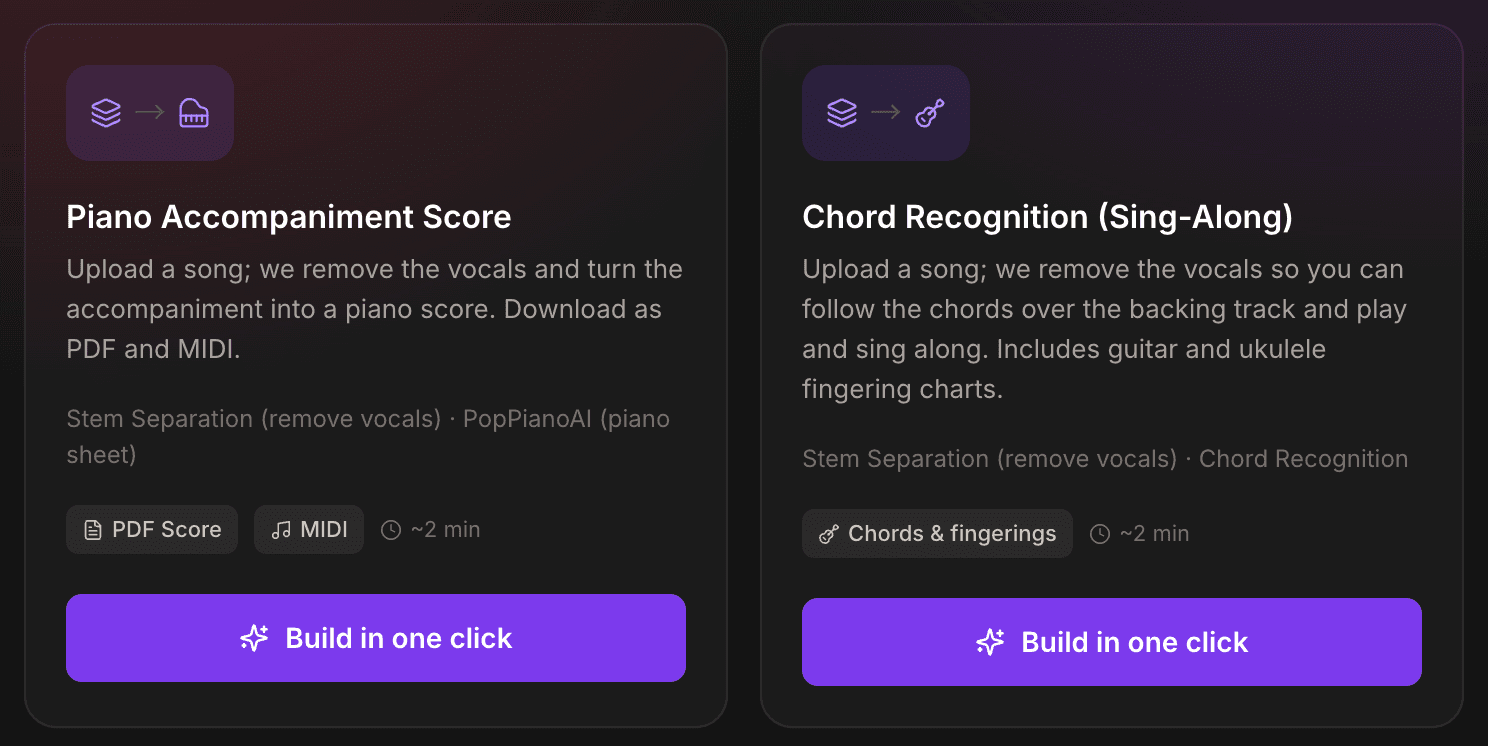
Forge is Muse Forge's template feature. Each template is a ready-made pipeline: pick one, drop in a song, and it chains several tools in order and hands you the finished result. There are two templates:
Piano Accompaniment Score | Chord Recognition (Sing-Along) | |
|---|---|---|
Pipeline | Remove vocals → PopPianoAI piano sheet | Remove vocals → Chord Recognition |
For | Accompanying a singer on piano | Playing and singing on guitar or ukulele |
You get | Online piano score and a vocals-removed backing preview, plus PDF, MIDI, MusicXML and piano audio downloads | A chord progression that plays over the vocals-removed backing, with guitar and ukulele chord diagrams |
Quota | Only the vocal-removal step, based on song length | Same |
Both take an uploaded audio file or a YouTube video link. The template cards say about 2 minutes; longer songs take longer.
Which tool should you use?
Ask one question first: who sings the melody?
- Someone sings (a friend or you), and the piano accompanies: use Forge's Piano Accompaniment Score. The vocals come out first, so the AI only hears the backing and the score centers on the accompaniment, mostly staying out of the singer's way.
- You play guitar or ukulele and sing: use Forge's Chord Recognition (Sing-Along). The audio player plays the backing without vocals, so you sing and follow the chords.
- You'll play the whole song on piano, no singing: use PopPianoAI. It arranges the song as a piano cover with the melody in it, so one person can make it sound complete. It's completely free.
- You only want the chords and don't mind hearing the original singer: plain Chord Recognition is all you need.
- You just want a vocals-removed backing track for karaoke: Stem Separation is all you need.
Make an accompaniment in three steps
Step 1: Pick a template
Open Forge, choose Piano Accompaniment Score or Chord Recognition (Sing-Along) under Start from a template, and press Build in one click. Each card lists the steps in the pipeline, what you get, and roughly how long it takes.
Step 2: Upload a song or paste a link
Drop an audio file into the upload area. MP3, WAV, FLAC, M4A, MP4 and other common formats work, up to 100 MB and 10 minutes long. You can also paste a YouTube video URL into the field above it; Forge shows the video's title and length so you can confirm it's the right one before you start.
YouTube downloads sometimes fail, so if you have the audio file, uploading it is the safest bet.
Step 3: Let it run, then take the result
Forge runs each step in order, and the Pipeline shows which one is in progress and which are done. Longer songs take longer: a song of just over four minutes takes about five. You can leave the page while it works and pick up where it left off when you come back.
If a step fails, press Retry this step to continue from there instead of starting over.
Piano Accompaniment Score: what you get
- An online piano score: it opens on the sheet music, with chord symbols marked and a cursor that follows playback. You can also switch to Performance View or the Piano Roll.
- A backing-track preview: the accompaniment with the vocals removed, so you can hear how the original backing goes before you practice from the score.
- Downloads: print the PDF and put it on the music stand; import the MIDI or MusicXML into a DAW or notation app to change the key or rework the arrangement. There's also an audio file of the piano version.
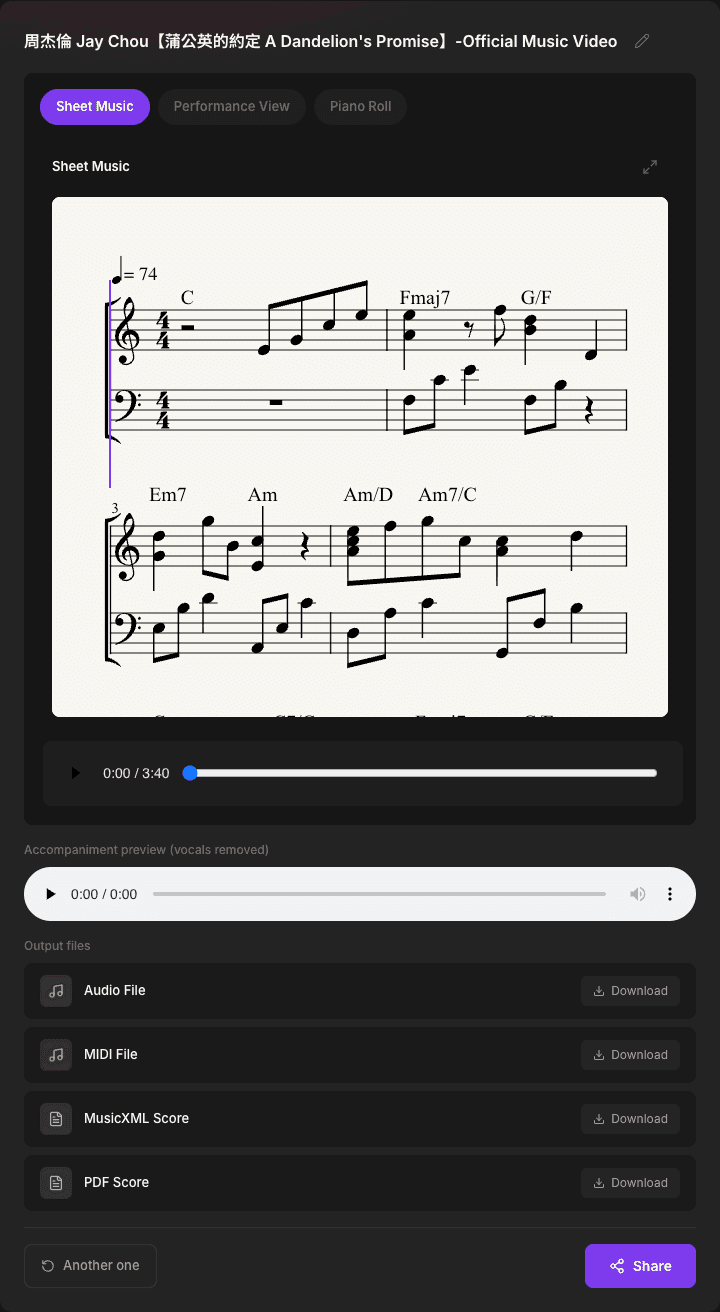
The AI arranges this score from the backing track, so play through it once before you rehearse and adjust anything that feels awkward. To match the singer's key, importing the MIDI or MusicXML into a notation app and transposing there is the easiest route.
Chord Recognition (Sing-Along): what you get
The result is the full Chord Recognition screen. The difference is that the player plays the backing track with the vocals removed:
- Chord progression: laid out by bar with the tempo (BPM), moving along with the backing. Click any cell to jump there. Press Degrees to see Roman numerals such as I, IV and V instead.
- Guitar and ukulele chord diagrams: Active shows the current and next chord; Overview lists every chord in the song. Most common chords have three or four shapes to choose from, and the ones you pick are saved automatically.
- Key and advanced chords: if the song sits too high, change the Key and every chord follows. By default you see simplified, easy-to-play chords; turn on Advanced chords to see full voicings like 9ths, 11ths and sus chords.
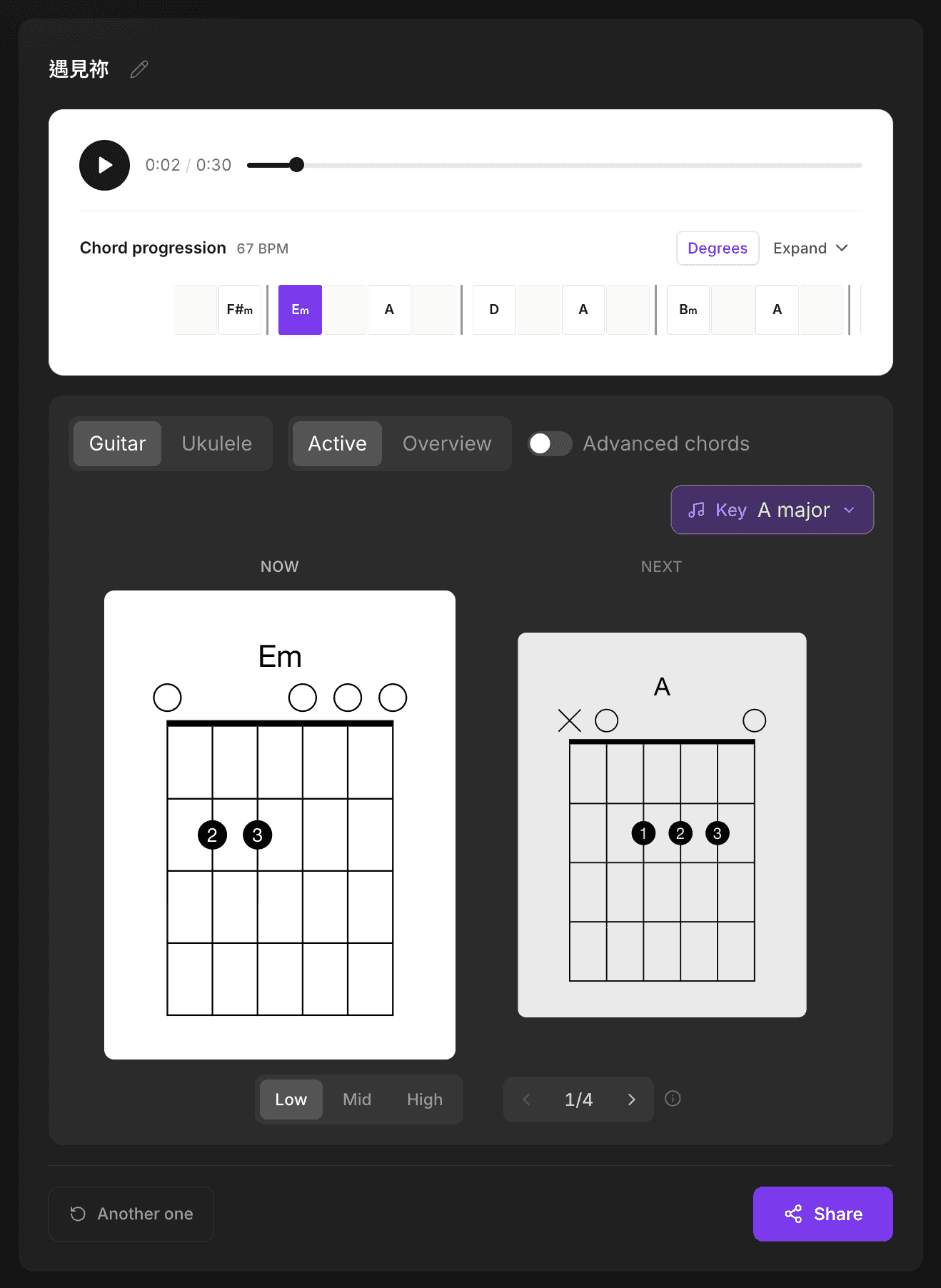
The backing plays, the chords are in front of you, and you sing the melody. That's a play-and-sing practice sheet. The AI won't get every chord right, so if something sounds off, check it by ear.
Forge now has a third template, Change Key + Split Vocals: pick how far to move the key, upload a song, and get the backing track (with backing vocals), an instrumental and the lead vocal, all in that key. See Change the Key of Any Song Online for how it works.
How much quota does it use?
In both templates, only the Stem Separation (remove vocals) step uses quota, based on the song's length. The piano transcription and chord recognition steps are free. Quota is shared with Music Generation, Stem Separation and Chord Recognition, and a free account can try it. If you use it a lot, see the paid plans.
Please upload audio you have the right to use. Before making an accompaniment score or chord chart from a recording, make sure you own it or have permission to use it.
FAQ
How is this different from a PopPianoAI score?
PopPianoAI listens to the whole original song and arranges a piano cover with the melody in it, so one person can play the entire song. Forge's Piano Accompaniment Score removes the vocals first, so the AI only hears the backing and arranges a score centered on the accompaniment, for playing piano while someone sings.
How is the Sing-Along template different from Chord Recognition?
Chord Recognition plays the original song, singer included. The Sing-Along template removes the vocals first, so the player plays the backing track and you sing the melody yourself while following the chords. Chord diagrams, key change and advanced chords work the same in both.
Are the chords more accurate once the vocals are removed?
Not noticeably. Chord Recognition already handles songs with vocals, and removing them first makes no clear difference to accuracy. The benefit is in playback: you hear the backing without the singer, so you can sing the melody yourself. The AI won't get every chord right, so if something sounds off, check it by ear.
How much quota does it use? Is it free?
In both templates, only the Stem Separation (remove vocals) step uses quota, based on the song's length. The piano transcription and chord recognition steps are free. Quota is shared with Music Generation, Stem Separation and Chord Recognition, and a free account can try it.
Which files can I download?
The Piano Accompaniment Score result offers four downloads: a PDF score, MIDI, MusicXML, and an audio file of the piano version. Print the PDF as is; import the MIDI or MusicXML into a DAW or notation app to edit it. The Sing-Along template has no file downloads; you read the chords and practice right on the result page.
Which formats work? Can I paste a YouTube link?
You can upload MP3, WAV, FLAC, OGG, AAC, M4A, MP4, OPUS or WebM, up to 100 MB and 10 minutes long. You can also paste a YouTube video URL (playlists and channel links don't work). YouTube downloads sometimes fail, so if you have the audio file, uploading it is the most reliable option.
What if a step fails partway through?
The pipeline shows which step failed. Press Retry this step to pick up from there instead of starting over, or go back to the templates and start again.
Can I share the result?
Yes. The result page has a Share button, and whoever opens the link can see it without signing in. A shared Sing-Along page keeps the chord shapes you picked, which is handy for bandmates or students.
One song in, an accompaniment out
No removing vocals, downloading and re-uploading to another tool. Pick a template, drop in a song, and start practicing a few minutes later.
New to Muse Forge? Read the full introduction.